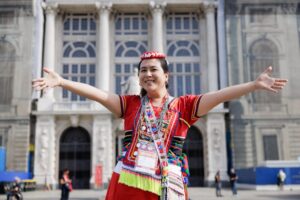
1,500 delegates from 125 countries gather in Turin as the President of the Italian Republic joins the opening of the 16th edition of Terra Madre and the Slow Food Participants’ Assembly
A Ukrainian farmer keeping an endangered cattle breed alive near the front line. Indigenous communities across Asia protecting ancestral knowledge threatened by climate change. Latin American networks preserving seeds, memory and territories. Young leaders in Somalia strengthening local food systems in the face of drought, conflict and displacement.
Their stories converge in Turin today for the opening of the world’s largest international event dedicated to the future of food systems.
Over four days, they come together around this year’s theme, “Biodiversity – Be Diversity”, exploring biodiversity not only as the foundation of healthy food systems, but as a powerful response to a world increasingly shaped by conflict, exclusion, ecological breakdown and political polarization.
The opening ceremony also marks the start of the Slow Food Participants’ Assembly, where delegates representing communities from around the world will define the movement’s political priorities for the next four years.
This edition carries particular significance for Slow Food. It is the first Terra Madre to take place without Carlo Petrini, whose vision transformed a small Italian association into a global movement uniting farmers, fishers, herders, Indigenous peoples, cooks, food artisans, researchers and activists around a shared belief: that food can change the world.
In a message to participants, King Charles III described Carlo Petrini as someone who “represented sanity, humanity and civilized values in a world that needs them so desperately,” adding that today “the mission of the Slow Food movement seems more crucially and urgently important than ever.”
“In a world increasingly shaped by walls, fear and exclusion, Terra Madre is proof that another path is possible,” said Edward Mukiibi, President of Slow Food. “Every day, our network demonstrates that people from different cultures, languages, religions and histories can work together around a common goal. Borders may define nations, but they should never divide humanity.”
Biodiversity as a culture of peace
For Slow Food, biodiversity goes far beyond the conservation of seeds, animal breeds and ecosystems. It lives in languages, cultures, knowledge systems and the countless ways communities grow, prepare and share food. As monocultures spread across fields, markets as well as in public discourse, biodiversity offers a different path: one based on resilience, reciprocity and coexistence.
“The opposite of biodiversity is not simply uniformity, it is extinction,” said Edward Mukiibi. “When we lose biological and cultural diversity, we become more fragile as societies. Protecting diversity means protecting our capacity to adapt, to coexist and to imagine a shared future”
Barbara Nappini, President of Slow Food Italy, described the delegates of the Terra Madre network as the protagonists of the agroecological transition already underway across the world. Their work demonstrates how diversity can become a force for change, inspiring practical, community-led solutions and offering a different vision of food production, one rooted in care for the Earth rather than its depletion.
The opening ceremony brings together delegates whose personal experiences reflect many of the challenges facing communities around the world.
From Ukraine, Yuliia Pitenko shared the story of farmer Polina Zhovtiak, who continues to care for sixty Ukrainian Red Steppe cattle, an endangered local breed included in the Ark of Taste, Slow Food’s catalogue of food biodiversity, on a farm not far from the front line.
“War has destroyed many physical bridges in Ukraine,” said Pitenko. “Our work is to keep the other bridges alive, between people, communities, food and the land, and to keep building new ones.”
From the Indigenous Peoples’ Network in Asia-Pacific, Xu Kung-Lien spoke about the growing pressures facing communities across the region, from extreme weather events in Taiwan to forest fires in Indonesia and devastating floods in the Himalayan region. Drawing on Indigenous knowledge and community practices, she argued that resilience is built not through isolation, but through mutual care, the sharing of knowledge and collective action.
“When disasters strike, we do not wait. We clean the mud, share meals and restore the land together. Indigenous wisdom is not meant to be kept as a secret. We share our seeds, our skills and our stories. We cannot stop the storms alone, but together we become stronger than any storm.”
From the Americas, Ireri Origel reflected on the multiple forms of division affecting communities across the continent, from inequality and displacement to biodiversity loss and social fragmentation. Drawing on her experience working with farmers, seed guardians and farmers’ markets, she argued that food can create spaces where people reconnect, exchange knowledge and learn to listen to one another.
“Dialogue does not begin when we find an answer. It begins when we create the conditions for people to come together. When we cook together, we share tasks. When we eat together, we share stories. Food reminds us that our differences do not have to divide us.”
From Africa, Mohamed Abdikadir Somo shared a different perspective on Somalia, a country too often portrayed only through conflict, drought and displacement. Drawing on the experience of communities rebuilding trust and livelihoods after decades of instability, he spoke about the role of food, projects such as Slow Food’s Gardens in Africa and collective action in creating opportunities, restoring dignity and bringing people back together.
“For more than three decades, Somalia has often been known to the world through conflict and crisis. But this is not the whole story. Somalia is also a country of farmers, pastoralists, fishers, cooks and young people carrying extraordinary knowledge, traditions and resilience. What crisis divides, communities can rebuild together.”
A message to the President of the Italian Republic and all decision makers
During the ceremony, Slow Food President Edward Mukiibi presented a letter on behalf of the Terra Madre network to the President of the Italian Republic, who remembered Carlo Petrini with gratitude and admiration, acknowledging the enduring impact of his work in Italy and around the world.
Signed symbolically by a global community of farmers, fishers, pastoralists, Indigenous peoples, cooks, researchers, teachers and activists, the letter called for renewed commitment to peace, international cooperation, ecological responsibility and food justice by all political institutions.
“Together, let us remind political leaders everywhere that peace, food justice and the protection of biodiversity are political choices. The task before us is to come together to nourish people, protect biodiversity, care for our planet and leave a better future for those who come after us. The world needs communities courageous enough to imagine a different future and determined enough to make it real”, concluded Mukiibi.
Over the coming days, Terra Madre Salone del Gusto will host hundreds of conferences, debates, educational activities and tastings, bringing together producers, cooks, academics, policymakers and citizens from around the world to share common strategies and commitments to secure food justice and a liveable world for all.
The 2026 edition of Terra Madre Salone del Gusto is made possible thanks to the support of institutions and companies that have already confirmed their commitment to the event. The event’s Main Partners are Acqua S. Bernardo, BBBell, Camera di Commercio di Torino, Iren, Pastificio Di Martino, QBA – Quality Beer Academy and Reale Mutua. In-kind Partners are Bormioli Luigi, Coop Italia, IP Industrie and NTT DATA Italia; Green Partners are Consorzio Ricrea and PEFC Italia; and Area Partners are Alberto Marchetti, Arix Professional, Baratti & Milano, Caffè Costadoro, Consorzio del Parmigiano Reggiano, Sebach and Tucano. Federalberghi Torino is the Hospitality Partner, while Bus Company is the Mobility Partner. Turismo Torino e Provincia also collaborates with the event. Nikon is the Media Partner and the Central Institute for Intangible Heritage (ICPI) is the Cultural Partner. The event is also held under the patronage of MASAF and ISMEA, with the support of Fondazione Compagnia di San Paolo, Fondazione CRT, Consulta delle Fondazioni di origine bancaria del Piemonte e della Liguria, and with contributions from the European Union, the LIFE Programme, IFAD, the W.K. Kellogg Foundation, Tamalpais Trust, Meatless Monday, IILA and GIZ.


INDEPENDENT NEWS IS IMPORTANT.
Enjoy reading Eco Voice? Please help us by purchasing a GIFT Voucher or send one to a friend and encourage people to purchase trees or seeds via The Native Shop – www.nativeshop.com.au

Plants, seeds & more delivered to your door!