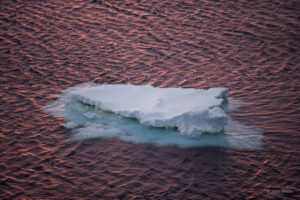
Photo © John Weller
Despite a valiant effort to reach agreement on new marine protected areas and improved management measures for the Antarctic krill fishery, two weeks of talks in Hobart closed today without agreement on key conservation measures. It is the tenth consecutive year that the Commission for the Conservation of Antarctic Marine Living Resources (CCAMLR) has failed to designate a new MPA, despite clear science and proposals that are ready to adopt.
Every October, CCAMLR Member governments come together to discuss the protection and management of Antarctica’s Southern Ocean. CCAMLR decisions require consensus, meaning an objecting Member is able to stop a new decision. Consequently, many important environmental protection measures have languished in CCAMLR for decades. Despite these shortcomings, hope is not lost. While negotiations weren’t able to get new marine protected areas over the finish line this year, key Members agreed to build on negotiation momentum with an intersessional meeting to advance negotiations on the Domain 1 MPA and a revised krill fishery management regime for adoption at CCAMLR-46.
José María Figueres, Chair of Antarctica2030 and former President of Costa Rica:
“Antarctica has a long history of successful international cooperation. The science is clear, the proposals are ready, and the political support is within reach. The health of the planet depends on conserving Antarctica and the Southern Ocean, so CCAMLR must persist in its efforts to achieve consensus. It is CCAMLR’s responsibility to protect the Southern Ocean. The world cannot wait.”
John Kerry, former US Secretary of State:
“Ten years ago, CCAMLR members found common ground to create a groundbreaking marine protected area in the Ross Sea. Built on equal parts science, negotiation, and persistence, it only happened because leaders put aside enormous geopolitical differences and decided to finish the job. This year, nations have come closer to another breakthrough agreement, and that is encouraging, especially in divided, polarized times. But close enough isn’t enough. History will judge this moment by whether what was outlined in Hobart is pushed across the finish line. The diplomacy of the next twelve months has to be every bit as determined as the diplomacy that brought CCAMLR to the edge of a victory for the ocean.”
Antarctica2030, a global movement uniting leaders to champion the protection of Antarctica’s Southern Ocean, is deeply concerned about the current state of Antarctic protection, but finds hope in the constructive discussions surrounding the pending MPA proposals. Notably, Argentina and Chile championed their Antarctic Peninsula (Domain 1) MPA with determination throughout the meeting, with many delegations working alongside them to build support and find common ground. China also introduced a new MPA proposal this year. Together, these developments demonstrate that despite the lack of consensus, opportunities for progress remain.
Lord Zac Goldsmith, former UK Environment Minister and Antarctica2030 Champion:
“After ten years of stalemate, the deadlock does seem to be cracking, and that matters. But penguins, seals and whales cannot feed on good intentions. Governments must spend the coming months closing the remaining gaps, not reopening them, and come to CCAMLR-46 ready to adopt marine protected areas.”
In 2009, CCAMLR became the first international body to commit to a representative system of MPAs across an entire ocean region. Over fifteen years after CCAMLR’s original commitment, the scientific case for conservation is stronger, the international mandate for ocean protection is clearer, and the need for multilateral cooperation is more urgent than ever. Protected areas for the Antarctic Peninsula, East Antarctica and the Weddell Sea would safeguard millions of square kilometres of critical habitat, from krill nurseries to whale feeding grounds, and make one of the single largest contributions to the global goal of protecting 30 per cent of the ocean by 2030. The time has come for CCAMLR to reclaim its position as a global conservation leader.
Monica Medina, Antarctica2030 Champion and former US Assistant Secretary of State for Oceans:
“With the first COP of the High Seas Treaty just months away, the tide is turning on ocean conservation. Some may think that the ocean is too big to fail; it is not. CCAMLR must catch up on its commitment. Now is the time for the Commission to redouble its efforts to regain its role as a conservation pioneer. With a network of Southern Ocean MPAs awaiting adoption, this is the moment to forge ahead with diplomacy and courage.”
Geneviève Pons, Vice Co-Chair of Antarctica2030 and President of Europe Jacques Delors:
“Protecting the Southern Ocean is not only an environmental priority, but it is also a test of international cooperation in a fragmented world. The 30×30 target cannot be met without the Southern Ocean and the high seas. The European Union and its member states must continue to treat Antarctic protection as a diplomatic priority of the first order and build the consensus that was missing in Hobart well before CCAMLR-46.”
Leaders must use the year ahead to reset negotiations at the highest political level, so that CCAMLR-46 delivers on its commitment to establish a representative system of MPAs, beginning with the Antarctic Peninsula MPA, hand in hand with a revised krill fishery management agreement that protects wildlife from concentrated fishing.
Steven Guilbeault, Antarctica2030 Champion and Canada’s Minister of Environment and Climate Change from 2021-2025:
“In Montreal in 2022, nearly 200 countries promised to protect 30% of the planet’s land and ocean by 2030. We cannot keep that promise without the high seas, and in the Southern Ocean, the proposals are ready. What happens around Antarctica affects all of us, from regulating the world’s climate to distributing nutrients across the global ocean. Antarctica should not have to wait for another year. While many countries worked hard to get a deal this year, all Members must come together at the highest political level to ensure agreement on protecting the Antarctic Peninsula when CCAMLR meets again next year.”

INDEPENDENT NEWS IS IMPORTANT.
Enjoy reading Eco Voice? Please help us by purchasing a GIFT Voucher or send one to a friend and encourage people to purchase trees or seeds via The Native Shop – www.nativeshop.com.au

Plants, seeds & more delivered to your door!