By Claudio Galimberti, Chief Economist, Rystad Energy:
“Markets are increasingly looking through mounting pressures: the geopolitical stalemate in Ukraine and the Gulf, an almost certain Federal Reserve rate hike in December, Treasury yields again above 5% and a stronger dollar squeezing energy importers.
Yet equities have recovered most of their post-midterm losses, as investors continue to price in the promise of AI-driven returns.
That is the contradiction: valuations are increasingly concentrated; profitability questions are mounting and the market’s tolerance for bad news is thinning.
A correction is unlikely to trigger a financial crisis given the expansion is largely equity-financed, but it could erode household wealth and force the economy into a slowdown.
For energy markets, the bigger risk is that weaker investor confidence delays data center projects beyond 2027, tempering expected growth in US power and gas demand just as the oil market enters a period of oversupply beneath a persistent geopolitical premium.
The question is how long markets can sustain this disconnect. Nvidia’s earnings and Anthropic’s IPO this week will provide an early test.”
Diplomacy is gaining momentum but delivering little progress.
US-brokered Russia-Ukraine talks have failed to narrow fundamental differences, while the Middle East is settling into a precarious “no war, no peace” equilibrium.
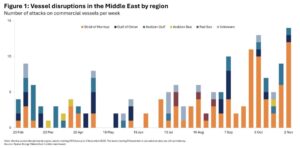
Recovering crude flows through the Strait of Hormuz have eased immediate supply pressures, but shipping disruptions, tight product markets and elevated geopolitical risks persist.
Venezuela’s gradual reintegration offers longer-term supply potential, although greater US congressional scrutiny could complicate investment.
Meanwhile, stubborn US inflation has made a December Federal Reserve rate hike almost certain. Rising Treasury yields and a stronger dollar are tightening global financial conditions, particularly in energy-importing economies. Equity markets have recovered from their post-midterm sell-off, but the resilience masks growing vulnerabilities.
AI sits at the center of this contradiction.
Investment is approaching historically high levels, equity valuations are concentrated, and questions about profitability are mounting.
Yet history suggests that revolutionary technologies can generate disastrous investment returns without derailing technological progress.
Unlike previous investment bubbles, AI expansion remains predominantly equity-financed, reducing the likelihood of a systemic financial crisis.
A correction could nevertheless damage household wealth, weaken investment and trigger a slowdown.
For energy, the implications are asymmetric. Near-term oil fundamentals are loosening, but geopolitical premiums persist.
Meanwhile, AI investment underpins much of the expected growth in US electricity and natural gas demand. A financial correction could therefore delay data center projects, particularly beyond 2027, without reversing the structural increase in power consumption.
The central question is whether resilient markets can continue absorbing simultaneous geopolitical, monetary and technological shocks, or if thinning buffers are bringing us closer to a breaking point.
Geopolitics: More diplomacy but little progress
The US-brokered talks between Russia and Ukraine in Abu Dhabi last week ended without a breakthrough.
The sides agreed in principle to a prisoner exchange but remain far apart on territorial concessions and security guarantees.
Moscow is also seeking to broaden negotiations to Europe’s security architecture, potentially making a settlement even harder.
Meanwhile, Russia continues to strike Ukraine’s energy infrastructure ahead of winter, while Ukrainian attacks on Russian refineries are adding pressure on Moscow.
Diplomatic engagement has resumed, but the underlying positions remain largely unchanged.
Following the US midterms, the US administration led by President Donald Trump appears more comfortable avoiding another round of large-scale strikes while maintaining its naval blockade and economic pressure on Iran.
Tehran, for its part, continues to demand sanctions relief and an end to the blockade before substantive negotiations can begin, leaving neither side willing to move first.
For oil markets, the recovery in physical flows has reduced some of the pressure for a diplomatic breakthrough.
However, this does not amount to a normalization. Attacks on vessels continue, shipping and insurance costs remain elevated, and refined product and gas flows are still lagging crude.
The current equilibrium could persist for some time, but the risk of renewed escalation remains significant.
Elsewhere, Venezuela took another step towards reintegrating into global oil markets this week, with ExxonMobil signing a preliminary agreement to evaluate potential investments in the country.
The development follows the Democrats’ victory in the US midterm elections, which could bring greater congressional scrutiny of the Trump administration’s oil arrangements with Caracas.
Macro: A December Fed hike firms up as markets reassess the midterm fallout
Hotter-than-expected US inflation data last week, coming on the heels of Fed Governor Christopher Waller’s remark that a 50-basis-point hike could be considered, made a December rate hike appear almost certain, with market attention now focused on its size.
Equity investors, meanwhile, looked past much of the post-midterm sell-off in AI-related stocks, even as Nvidia’s chief executive officer Jensen Huang stepped down.
The repricing that followed the midterms is still at an early stage, and the political risks associated with a Democratic Congress could become more pronounced in 2027.
The coming week also brings two key events for the AI industry – Nvidia’s earnings release on Tuesday and Anthropic’s initial public offering, which is reportedly set to price on Wednesday.
Headline consumer prices rose 0.4% month-on-month in October, while core prices advanced 0.3%. Each reading came in at a tenth of a percentage point above consensus, marking the third consecutive core inflation reading of 0.3%.
No annual rates were published, since October 2025 prices were not collected during the government shutdown.
Waller, who still favors a 25-basis-point move as his baseline, had said before the release that a half-point hike should be considered if core inflation rose 0.3% or more for a third month, and October’s data met that threshold.
In the days after the election, falling oil prices, cheaper gasoline and the prospect of slower AI investment had looked to strengthen the case for the Fed to hold rates, but last week’s data weakened that argument.
Markets now price a December hike as near-certain, with an approximate chance of 10% of a 50-basis-point move. Rystad Energy’s baseline remains unchanged at a 25-basis-point hike in December, followed by one more in the first half of 2027.

Tech stocks recovered despite the prospect of a higher cost of capital, leadership disruption at one of the industry’s largest companies and mounting political headwinds, which points to investors’ continued confidence in AI.
The impact of higher rates is falling instead on the more rate-sensitive parts of the economy, with existing home sales falling 5.5% in October to their lowest level in more than 16 years.
Tighter regulation in key data center states is a genuine headwind, but the proposed pauses target new approvals and are therefore likely to hit projects still awaiting permits rather than those already under construction.
Most of the capacity due in 2027 should already be underway, which puts the risk on 2028 and beyond rather than on next year’s pipeline. For now, markets appear willing to await greater clarity.
The strength in tech was particularly notable given Jensen Huang’s resignation as Nvidia’s chief executive officer on 12 November.
The company’s shares tumbled about 13% over last week and incoming Democratic committee chairs are reportedly preparing investigations for next year, adding to concerns around the AI boom.
Nvidia has become a key source of funding and support across the AI industry, backing customers and partners across the supply chain, signaling that the choice of its next leader has implications beyond its own share price.
For energy, data centers are the main source of growth in US power demand, and we expect their electricity consumption to rise 43% this year to about 387 terawatt-hours (TWh), with a growing share of new capacity planning to run on on-site gas generation.
Despite higher costs of capital for long-lead projects and mounting political headwinds for data centers, energy stocks rebounded more strongly than the broad market last week, with the Energy Select Sector SPDR (XLE) up 5.4% against 2.5% for the S&P 500.
However, this only partly reversed the previous week’s slide, and XLE closed the week 7.2% below its level on the Friday before the midterms.

What to watch from here
Higher-than-expected US inflation has firmed up a December Fed hike, and although equities quickly reversed much of the midterm sell-off, the moves elsewhere are less benign for energy.
Rising yields and a stronger dollar weigh on global economic activity and energy demand, particularly in importing countries that pay for oil and liquefied natural gas (LNG) in weaker currencies.
In the coming week, China’s October activity figures will show how much momentum the world’s second-largest economy and largest energy consumer still has. In Japan, third-quarter gross domestic product (GDP) released on 16 November showed no growth and will shape the outlook for the Bank of Japan together with this week’s inflation data.
For AI, Nvidia’s results on Tuesday are the main test of the investment cycle that underpins much of the expected growth in US power and gas demand, while Anthropic’s IPO may add volatility.
In oil, with a “no war, no peace” scenario taking hold as physical flows recover, shifts in the curve structure will matter as much as the geopolitical risk premium for near-term prices.


INDEPENDENT NEWS IS IMPORTANT.
Enjoy reading Eco Voice? Please help us by purchasing a GIFT Voucher or send one to a friend and encourage people to purchase trees or seeds via The Native Shop – www.nativeshop.com.au

Plants, seeds & more delivered to your door!